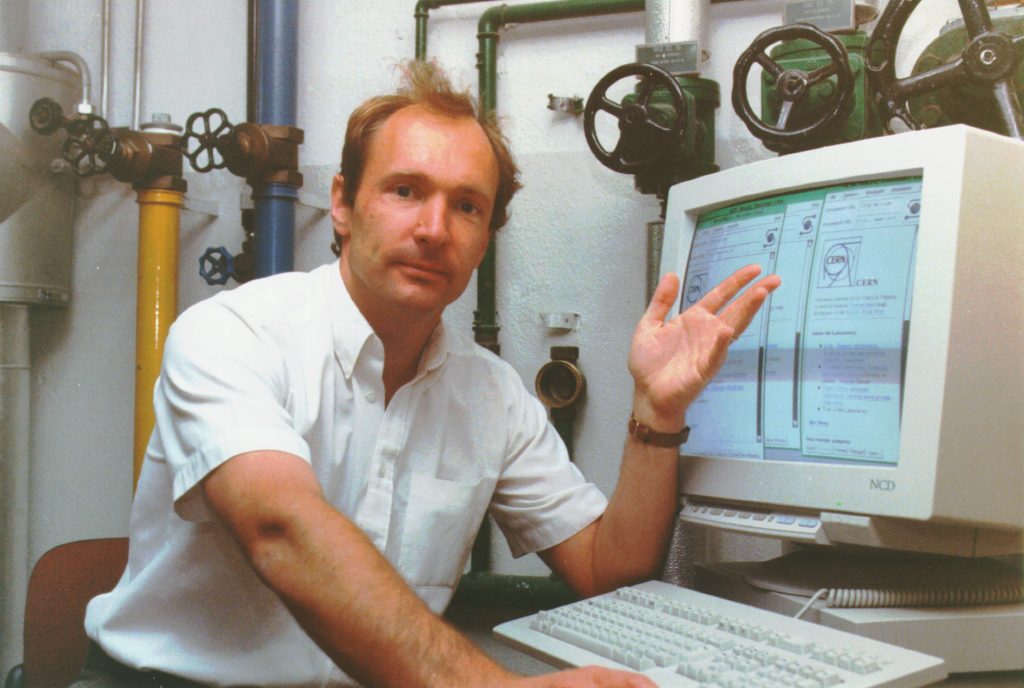
In 1991, a British scientist named Tim Berners-Lee changed the world forever by publishing files describing his idea for the World Wide Web. This innovation not only transformed the way we access and share information, but also revolutionised multiple aspects of society, from communication and education to commerce and entertainment.
Before the creation of the World Wide Web, the Internet already existed, but it was a much more limited and technical environment, used mainly by scientists and academics to share information using protocols such as FTP (File Transfer Protocol) and Telnet. Tim Berners-Lee, who worked at CERN (European Organisation for Nuclear Research) in Switzerland, saw the need for a more intuitive and accessible system for sharing information among scientists around the world.
Berners-Lee was inspired by various existing concepts, such as hypertext, a way of organising and linking information developed in the 1960s by Ted Nelson. However, it was Berners-Lee who had the vision to combine these concepts into a global information network accessible through web browsers.
In March 1989, Berners-Lee submitted a proposal to his superiors at CERN entitled ‘Information Management: A Proposal.’ This proposal detailed a hypertext-based system that would allow researchers to share and access documents on the network. Initially, the proposal received a lukewarm response, but Berners-Lee continued to develop his idea.
In 1990, with the help of his colleague Robert Cailliau, Berners-Lee produced a more refined version of the proposal. Finally, in December 1990, the first website was launched on CERN’s internal network, presenting the first practical demonstration of the World Wide Web.
HTML (HyperText Markup Language) is the markup language used to create and structure web pages. Berners-Lee developed HTML as a simple, standardised way to create documents that could be linked and viewed in different web browsers. HTML allowed users to create text, links, images, and other multimedia elements on a web page.
Another essential component of the World Wide Web is the URL (Uniform Resource Locator). URLs are unique addresses that identify specific resources on the web, such as web pages, images, and files. Berners-Lee designed URLs to provide a consistent way to locate and access resources on the web.
HTTP (HyperText Transfer Protocol) is the protocol used to transmit data across the web. HTTP defines how messages are formatted and transmitted, and how web servers and browsers should respond to various requests. This protocol is fundamental to communication on the World Wide Web.
To demonstrate his idea, Berners-Lee also developed the first web browser, known as WorldWideWeb (later renamed Nexus). This browser allowed users to view and navigate linked HTML documents, establishing the basic model for all web browsers that followed.
On 6 August 1991, Tim Berners-Lee published files online describing his idea for the World Wide Web. These documents included technical specifications for HTML, URLs and HTTP, providing the basis for other developers and users to begin building and expanding the web.
The World Wide Web grew rapidly during the 1990s. In 1993, the release of the Mosaic browser, developed by the National Centre for Supercomputing Applications (NCSA) in the United States, made the web accessible to a wider audience and facilitated its widespread adoption. Mosaic introduced a user-friendly graphical interface and support for embedded images, becoming a model for future web browsers such as Netscape Navigator and Microsoft Internet Explorer.
In 1994, Tim Berners-Lee founded the World Wide Web Consortium (W3C) at MIT (Massachusetts Institute of Technology) with the aim of developing standards and guidelines to ensure the long-term growth and interoperability of the web. The W3C remains a key organisation in the governance and evolution of the web.
The World Wide Web radically transformed the way people communicate and access information. Before the web, information was fragmented and often difficult to obtain. With the web, information became much more accessible, allowing anyone with an internet connection to easily search for and share knowledge.
In short, Tim Berners-Lee’s publication of files describing the idea of the World Wide Web in 1991 marked the beginning of a new era in human history. The web has transformed every aspect of our lives, from the way we communicate and learn to how we do business and entertain ourselves. Berners-Lee’s legacy is a testament to the power of innovation and collaboration to change the world. As we move into the future, the World Wide Web will continue to be a crucial platform for information, communication, and human progress.